Drawn Out of Power: How Gerrymandering Silences Religious Minorities and What Communities Must Do to Fight Back
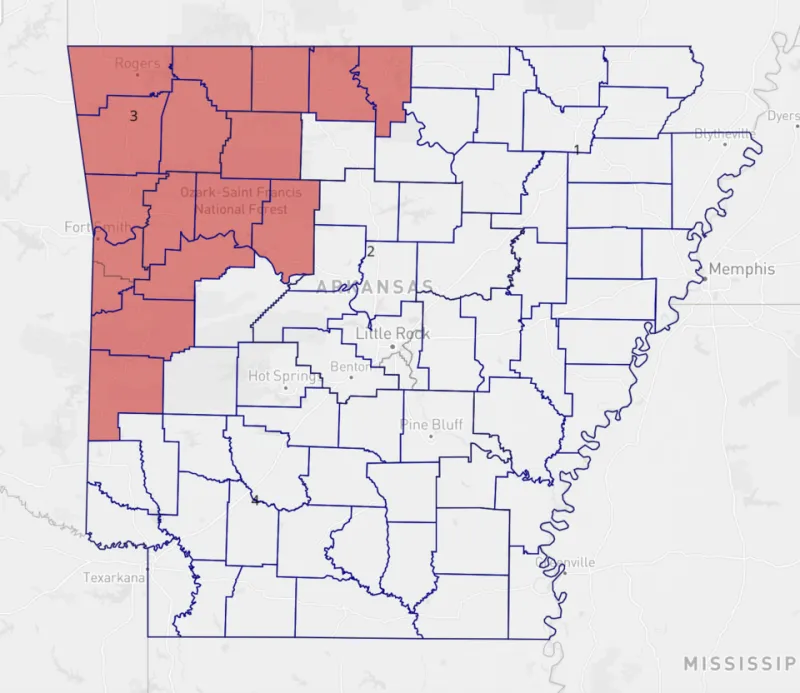
Photo: Arisingsun, CC BY-SA 4.0, via Wikimedia Commons
Every ten years, following the national census, state legislatures and redistricting commissions redraw the boundaries of congressional, state legislative, and local electoral districts. For most Americans, this process unfolds invisibly — a dry procedural matter handled by officials in committee rooms far from public scrutiny. For religious minority communities, however, redistricting is anything but invisible in its consequences. It determines whether a community's votes accumulate into real political leverage or dissipate harmlessly across carefully engineered boundaries.
The Arabic root of hakam — to judge, to govern with wisdom — implies that just governance cannot be passive. It requires communities to understand the machinery of power well enough to intervene when that machinery is rigged against them. Redistricting is precisely such a machine, and learning to read it is an act of civic self-defense.
How Maps Become Weapons
Gerrymandering takes two primary forms, each designed to neutralize the electoral influence of a targeted group. Cracking disperses a community across multiple districts so that it never constitutes a decisive voting bloc in any single one. Packing concentrates a community into one or two districts, manufacturing the appearance of representation while actually wasting votes that could have influenced several competitive races.
For religious minority communities — whether Muslim Americans concentrated in specific metropolitan corridors, Jewish communities anchored in particular suburban counties, or Sikh populations clustered in agricultural regions of California — both tactics have been deployed with measurable effect. In the 2021 redistricting cycle in Texas, Arab American and Muslim American advocacy organizations documented how communities in the Houston metropolitan area were cracked across newly drawn congressional boundaries, eliminating a district in which they had previously constituted a meaningful share of the electorate. Similar patterns emerged in New Jersey, where South Asian communities with significant Muslim populations found their neighborhoods divided between competing districts in ways that defied both geographic logic and any neutral reading of compactness standards.
These outcomes are not accidental. Modern redistricting is conducted using granular demographic data and sophisticated mapping software that allows line-drawers to predict, with considerable precision, how a given boundary configuration will affect electoral outcomes for specific population groups.
Reading the Map: What Communities Need to Know
The first practical step toward defending political power during redistricting is developing the capacity to read and analyze district maps. This is more accessible than it sounds. Several nonprofit organizations, including the Princeton Gerrymandering Project and the Brennan Center for Justice, provide free tools that allow community members to evaluate proposed maps against standards of fairness, compactness, and community cohesion.
Communities should focus on several key indicators when reviewing proposed district lines:
Compactness and contiguity. Legitimate districts are generally geographically compact and contiguous. Irregular shapes — long tentacles reaching into distant neighborhoods, or districts that connect disparate areas through narrow geographic corridors — often signal manipulation.
Communities of interest. Legal doctrine and most state redistricting standards require that mapmakers respect established communities of interest: groups that share common social, cultural, economic, or civic concerns. Religious minority communities that can demonstrate shared institutional infrastructure — houses of worship, schools, community centers, advocacy organizations — have a documented basis for arguing that their neighborhoods constitute a protected community of interest.
Population deviation. Federal constitutional standards require that congressional districts be drawn to near-mathematical equality in population. Significant deviations between districts, particularly when they correlate with demographic composition, can signal discriminatory intent.
Organizations such as the Arab American Institute and the Sikh Coalition have developed redistricting toolkits specifically tailored to their communities. Investing in training a cohort of community members as map literacy advocates before the next redistricting cycle begins in 2031 is one of the most high-leverage investments a faith-based organization can make today.
Lessons from the 2020 Cycle
The redistricting cycle that followed the 2020 census produced both cautionary examples and genuine victories worth studying. In Michigan, the establishment of an independent redistricting commission — achieved through a 2018 ballot initiative — created a more transparent process that allowed community organizations, including Arab American groups in the Dearborn area, to submit formal testimony and proposed maps. The result was a congressional district configuration that better preserved the geographic coherence of Arab American communities in Wayne County than previous cycles had achieved.
By contrast, in states where legislatures retained exclusive redistricting authority, community testimony was often procedurally accepted but substantively ignored. In Georgia, civil rights organizations documented how public comment periods were compressed and held at inconvenient times, effectively suppressing participation from working-class and immigrant communities — many of them members of religious minorities — who could not attend weekday daytime hearings.
The contrast between these outcomes underscores a critical lesson: the structural rules governing the redistricting process matter as much as the substance of any individual map. Communities that advocate for independent commissions, extended public comment periods, and mandatory community-of-interest analysis before the process begins are fighting the battle at the right level.
The Legal Landscape
Litigation remains a tool, though one with diminishing reach following the Supreme Court's 2019 ruling in Rucho v. Common Cause, which held that federal courts lack jurisdiction to adjudicate partisan gerrymandering claims under the U.S. Constitution. This decision shifted the legal battleground significantly toward state courts and state constitutional provisions, many of which contain stronger anti-gerrymandering language than the federal constitution.
Racial gerrymandering claims under Section 2 of the Voting Rights Act remain viable in federal court, and religious minority communities whose members are also racial minorities — Arab Americans, South Asian Americans, and others — may have standing to bring such claims when maps can be shown to dilute the voting strength of a protected racial group. The National Muslim Bar Association and similar professional organizations have been developing litigation frameworks that may support such claims in future cycles.
Building the Infrastructure for the Next Fight
The 2030 census and the redistricting cycle that follows it are less than six years away. That timeline sounds distant; it is not. The organizations that influenced the 2021 cycle most effectively began their groundwork in 2017 and 2018 — building coalitions, training advocates, collecting demographic data, and establishing relationships with state legislators and commission members before the process formally began.
Faith communities serious about political self-determination should be taking several concrete steps now. First, establish or join a statewide redistricting coalition that includes other minority communities with aligned interests. Second, invest in demographic mapping of your community's geographic distribution so that you can present credible community-of-interest arguments when the time comes. Third, identify and cultivate relationships with state legislators — particularly those on judiciary or elections committees — who will have influence over redistricting rules. Fourth, support ballot initiatives in your state that would create or strengthen independent redistricting commissions.
The lines on a map are not neutral. They are decisions — and decisions can be contested, challenged, and changed. A community that understands this, and that enters the redistricting process as an organized and informed participant rather than a passive subject, is a community that governs itself. That is what hakam demands.