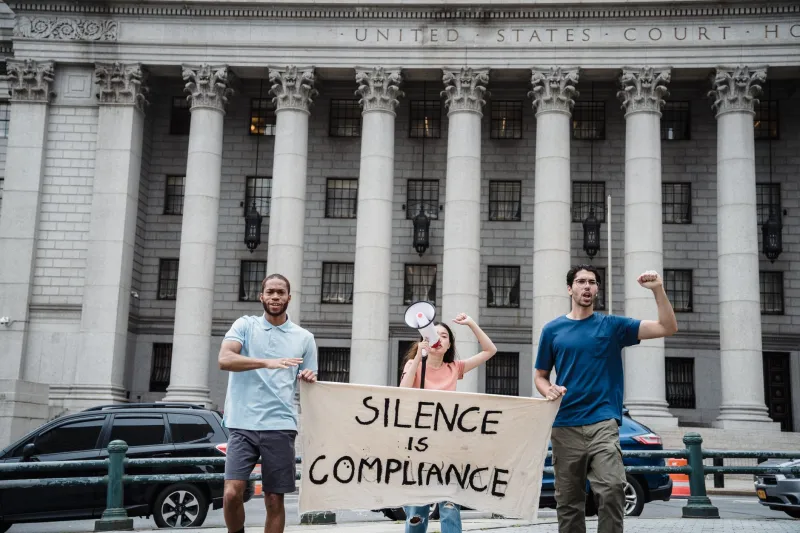
Priced Out Before the Gavel Falls: How Court Fees Are Locking Religious Minorities Out of Justice
There is a particular cruelty embedded in a justice system that promises equal protection under the law while simultaneously charging admission. For Amina Khalil, a Somali-American Muslim woman living in Minneapolis, that cruelty arrived in the form of a civil court filing packet. Seeking to contest an unlawful eviction from her apartment — one she believed was motivated at least in part by her visible religious identity — she was confronted with an initial filing fee of $322. That figure, she would soon discover, was only the beginning.
"They told me there was the filing fee, then a service fee, then a fee for the interpreter I needed, and then something called an administrative surcharge that nobody explained to me," Khalil recalled. "By the time I added it all up, I was looking at nearly $700 before anyone had even looked at my case."
Khalil's experience is not an anomaly. It is, according to legal aid advocates and community organizers, an increasingly common reality for low-income members of religious minority communities across the United States — communities that are, by measurable demographic patterns, disproportionately represented among the working poor and the uninsured, and disproportionately likely to face the kinds of civil legal disputes — housing, family law, debt collection, immigration-adjacent matters — that demand courthouse access.
The Anatomy of a Fee Cascade
To understand how court costs function as a barrier, one must first understand their structure. Filing fees represent only the most visible layer. In many jurisdictions, a civil case triggers a sequence of mandatory charges that compound rapidly.
In California, for example, a general civil complaint in a limited jurisdiction case carries a base filing fee of $225. Add a motion fee ($60), a jury fee deposit ($150 in many counties), fees for certified copies of documents ($25–$40 per document), and interpreter services (which, contrary to common assumption, are not universally provided at no cost in civil proceedings), and a low-income litigant can face upfront costs exceeding $600 before a single hearing date is set.
In Texas, the situation is compounded further by county-level assessments that vary widely and are rarely disclosed transparently in pre-filing materials. Immigrant-serving legal aid organizations in Houston and Dallas have documented cases in which clients, primarily from South Asian Muslim and West African Christian communities, abandoned legitimate legal claims after discovering the total projected cost of pursuing them.
Federal courts present their own formidable wall. The filing fee for a civil complaint in federal district court currently stands at $405 — a figure that has increased substantially over the past two decades and that does not include service of process, transcript fees, or the cost of obtaining electronic access to case documents through the PACER system, which charges per-page retrieval fees that can accumulate into hundreds of dollars over the course of complex litigation.
Who Bears the Burden
The distributional impact of these costs is not neutral. Research consistently demonstrates that religious minority communities in the United States — including Muslim Americans, Sikh Americans, members of various African Christian traditions, and communities of Jehovah's Witnesses and Latter-day Saints in lower-income brackets — face elevated rates of poverty relative to the general population. A 2021 Pew Research analysis found that Muslim Americans, as a group, report household incomes below $30,000 at rates significantly higher than non-Muslim Americans. Refugee-origin communities, many of which are organized around faith institutions, face even steeper economic precarity.
When courts charge fees that represent a week's wages for a low-income worker, they are not imposing a neutral inconvenience. They are making a structural decision about whose grievances are worth adjudicating.
"The fee system encodes an assumption that the people using courts have disposable income," said one civil rights attorney who works primarily with East African Muslim clients in the Twin Cities. "That assumption is not just wrong — it is discriminatory in its effect, even if not in its stated intent."
The Fee Waiver Illusion
Every state provides some mechanism for fee waivers — formal procedures by which indigent litigants can petition the court to proceed without paying filing costs. In theory, these mechanisms exist precisely to address the kind of access problem described above. In practice, they are riddled with barriers that make them functionally unavailable to many of the people who need them most.
The waiver application process itself requires documentation: proof of income, tax returns, benefit statements, bank records. For undocumented community members, or for individuals whose income is informal or irregular — day laborers, domestic workers, gig economy participants — assembling this paperwork is neither simple nor safe. Many applicants fear that submitting financial records to a court will expose them to scrutiny they cannot afford.
Further, waiver applications are not automatically granted. Judges retain discretion in many jurisdictions, and the standards for approval vary dramatically from courthouse to courthouse and, in some documented cases, from judge to judge. Community legal advocates in Southern California have catalogued cases in which fee waiver petitions from Arab American and Southeast Asian litigants were denied without explanation while comparable petitions from other applicants were approved.
Even where waivers are granted, they typically cover only the initial filing fee. Interpreter costs, transcript fees, and service fees frequently fall outside the scope of waiver coverage — meaning that a litigant who successfully obtains a fee waiver may still face hundreds of dollars in downstream costs that render full participation in their own case financially impossible.
What Communities Can and Must Demand
The path toward meaningful reform runs through both legislative advocacy and direct community organizing, and faith-rooted organizations are uniquely positioned to pursue both tracks simultaneously.
Demand Comprehensive Fee Waiver Expansion. State legislatures must be pressed to expand the scope of fee waivers to cover all mandatory court costs, not merely initial filing fees. Advocacy coalitions should work with sympathetic legislators to introduce bills that define "court costs" comprehensively and require automatic waiver approval for litigants at or below 200 percent of the federal poverty line.
Push for Standardized Fee Disclosure. Courts should be required to provide, at the point of initial inquiry, a complete itemized schedule of all fees a litigant is likely to encounter in their specific case type. This transparency requirement, which exists in consumer finance law but not in most court systems, would at minimum allow litigants to make informed decisions and would expose the full magnitude of the access problem to public scrutiny.
Invest in Community-Based Legal Navigation. Faith institutions can establish or expand legal navigation programs that help community members identify fee waiver eligibility, assemble required documentation, and submit applications correctly. These programs, which require no licensed attorneys to operate at the informational level, represent a high-leverage use of congregational resources.
Document and Publicize Disparities. Systematic data collection on fee waiver denial rates, disaggregated by the demographic characteristics of applicants, is essential to building the evidentiary record that legislative reform requires. Community organizations should partner with law school clinics and civil rights nonprofits to conduct this audit work and publish the results in formats accessible to both policymakers and the general public.
Engage Courts Directly. Many court administrators have more discretion than is commonly understood to modify fee structures, expand waiver eligibility, and create alternative payment arrangements. Organized community delegations — rooted in faith institutions and accompanied by legal advocates — can open negotiations with presiding judges and court administrators that yield concrete procedural reforms without waiting for legislative action.
Justice Cannot Be a Luxury
The principle that animates this publication — that justice must be accessible, accountable, and equitable — is flatly incompatible with a court system that prices out its most vulnerable users before they ever reach the threshold of a hearing room. For religious minority communities whose members already navigate surveillance, discrimination, and civic marginalization, the additional burden of financial exclusion from the courts is not a minor inconvenience. It is a compounding injustice that demands an organized, sustained, and morally serious response.
Amina Khalil, for her part, ultimately found a pro bono attorney through a local mosque-affiliated legal aid network and pursued her eviction case to a successful resolution. But she is clear-eyed about what her outcome required. "I was lucky," she said. "Most people I know just give up. They can't afford not to." That resignation — born not of apathy but of financial exhaustion — is precisely what the movement for court fee reform must refuse to accept as inevitable.