A Courtroom in the Kitchen: Why Remote Hearings Are Leaving Some Congregations Behind
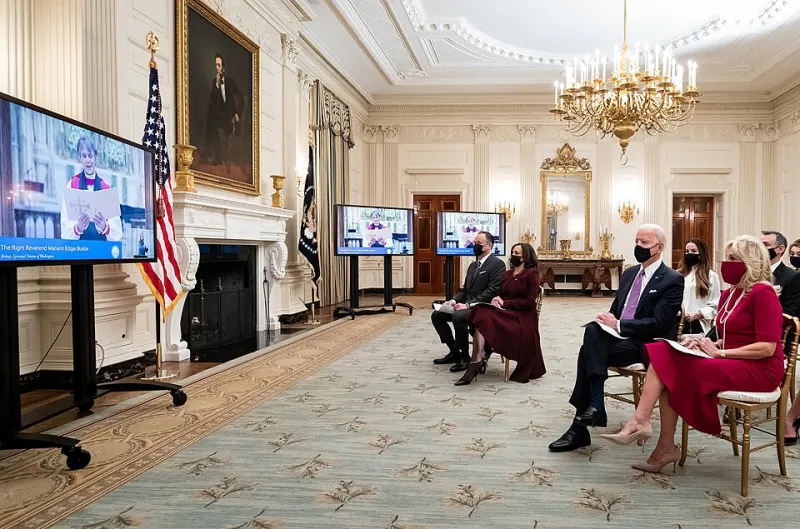
Photo: The White House, Public domain, via Wikimedia Commons
The notice no longer arrives by mail. It shows up as a text message with a link, a meeting ID, and a fifteen-minute window to test your camera before a judge appears on screen. For a growing number of Americans, the courthouse is now a browser tab — and for religious minority communities, that tab is frequently a locked door.
Landlord-tenant disputes, small claims, debt collection, traffic appeals, child support reviews, and an expanding share of family matters are now routinely conducted over video. The efficiency case is real: fewer continuances, less travel, faster calendars. But efficiency measured at the system level is not the same as access measured at the household level, and the gap between those two numbers is where justice quietly slips away.
The Promise of a Day in Court, Rendered in Pixels
The constitutional guarantee of meaningful participation rests on unglamorous assumptions: that a litigant can arrive, can be recognized, can speak, and can be understood. Remote proceedings strain all four.
Arrival now requires a functioning device, a stable connection, and a private room. Congregations in our network report households where a single phone is shared among five people, where data plans are metered, and where the only quiet hour of the day is after the children sleep — a schedule that rarely matches a 9:30 a.m. docket. Public libraries and community centers offer computers, but a courtroom appearance is not a fifteen-minute email check. It requires quiet, duration, and the ability to sit still through a wait that can stretch for hours.
Recognition is subtler. On a small screen, an accented English speaker, a woman in a headscarf, or a man in a kufi does not read as a sympathetic figure in a wood-paneled room. They read as a thumbnail. Judges and opposing counsel lose the ambient cues that humanize a person under pressure — and litigants lose the sense, however imperfect, of standing inside a public institution.
The Rooms We Cannot Show
Then there is the question of the room itself. Courts have long treated the home as private and the courthouse as public. Video hearings invert that: the most intimate space a family possesses becomes the stage for a stranger's scrutiny.
For many religious minority households this is not an abstraction. A Muslim family appearing from a living room where prayer rugs and a Qur'an are visible. A Sikh litigant asked to remove his turban to be "clearly identifiable" on camera. A Black church elder whose background reveals a home address already sought by a harassing creditor. A domestic violence survivor whose abuser, present in the same apartment, is technically off-screen but audibly in the room.
Some courts have rules about backgrounds and dress. Few publish them clearly, and fewer translate them. A litigant should never have to choose between an appearance standard written for a courtroom and the sanctity of a home.
Where the System Fails Quietly
Three failures recur across jurisdictions.
Interpretation is bolted on, not built in. Remote interpretation often runs through a third dial-in or a separate portal, so the interpreter hears a compressed, lagging version of testimony. Dialects and religious terminology suffer first — the difference between a marriage contract and a civil agreement, for instance, can turn on a single word.
Document handling is improvised. Courts ask parties to hold papers up to a webcam. For litigants with limited literacy in English, or whose documents are in another script, this is not a neutral process.
Technical failure is treated as fault. A dropped connection becomes a missed hearing becomes a default judgment. Judges have discretion, but discretion exercised without a written record of what happened at a kitchen table is discretion exercised in the dark.
What Communities Are Building
Faith-based legal clinics are responding with infrastructure rather than sympathy. Several congregations now run "remote hearing rooms" — a converted classroom with reliable internet, a desk, a lamp, a locked door, and a volunteer who knows how to log in twenty minutes early. Others pair litigants with digital navigators who test equipment the day before a hearing, and who file a written notice with the court documenting any technical barrier in advance.
Equally important is documentation. Community researchers are compiling dockets to measure how often remote hearings produce defaults, continuances, and failures to appear in neighborhoods with lower broadband adoption. That data turns anecdote into a record a city council can act on.
What to Demand
Advocates have a short, concrete list. Courts should offer a telephone-only option that carries the same legal weight as video. Appearance standards should be published in plain language and in the languages of the communities served. Courts should permit neutral virtual backgrounds and prohibit demands that litigants remove religious head coverings. Interpreters should be invited into the primary session, not a secondary line. And every jurisdiction should publish failure-to-appear data disaggregated by ZIP code.
None of this requires new constitutional theory. It requires the same thing courts have always required of themselves: that the ritual of being heard be available to everyone who is summoned. A gavel on a screen is still a gavel. It should carry the same obligation.